D&D stat roller
Roll your 5e ability scores the classic way: four six-sided dice, drop the lowest, six times. See every die, check how the set compares with the standard array, then place the scores and add your bonus.
- Strength 15 Cost null Bonus 0 Score 15 Modifier +2
- Dexterity 14 Cost null Bonus 0 Score 14 Modifier +2
- Constitution 13 Cost null Bonus 0 Score 13 Modifier +1
- Intelligence 12 Cost null Bonus +2 Score 14 Modifier +2
- Wisdom 10 Cost null Bonus +1 Score 11 Modifier +0
- Charisma 8 Cost null Bonus 0 Score 8 Modifier −1
null points left of 27
+5 modifier total before bonuses
The standard array adds up to +5. Point buy builds add up to +3 to +7.
Press Roll to roll six scores, or type your own below.
Earlier sets
Background bonus
House rules
Unofficial fan tool, not affiliated with Wizards of the Coast. Your build is saved in this browser and in the page link.
How to use the stat roller
Pick a rolling method
4d6, drop lowest is the method in the rules. Your table may use 4d6 with 1s rerolled, 3d6, or 2d6 + 6 instead.
Roll
Press Roll to roll six scores. Each one shows its dice, with the dropped die struck through. Your last five sets stay listed so you can go back to one.
Place the scores
Each roll lands on an ability in order. Pick a different number in any ability's list to swap two scores, or Start from a class to sort the set for that class.
Add your bonus
Choose 2024 rules for a background bonus or 2014 rules for a race bonus. Copy scores gives you the final numbers for your character sheet.
How 4d6 drop lowest works
Roll four dice and ignore the lowest one. A roll of 6, 4, 3 and 1 gives 6 + 4 + 3 = 13. Rolling a fourth die and dropping the worst result pushes scores up: the average is 12.24, against 10.5 for three dice.
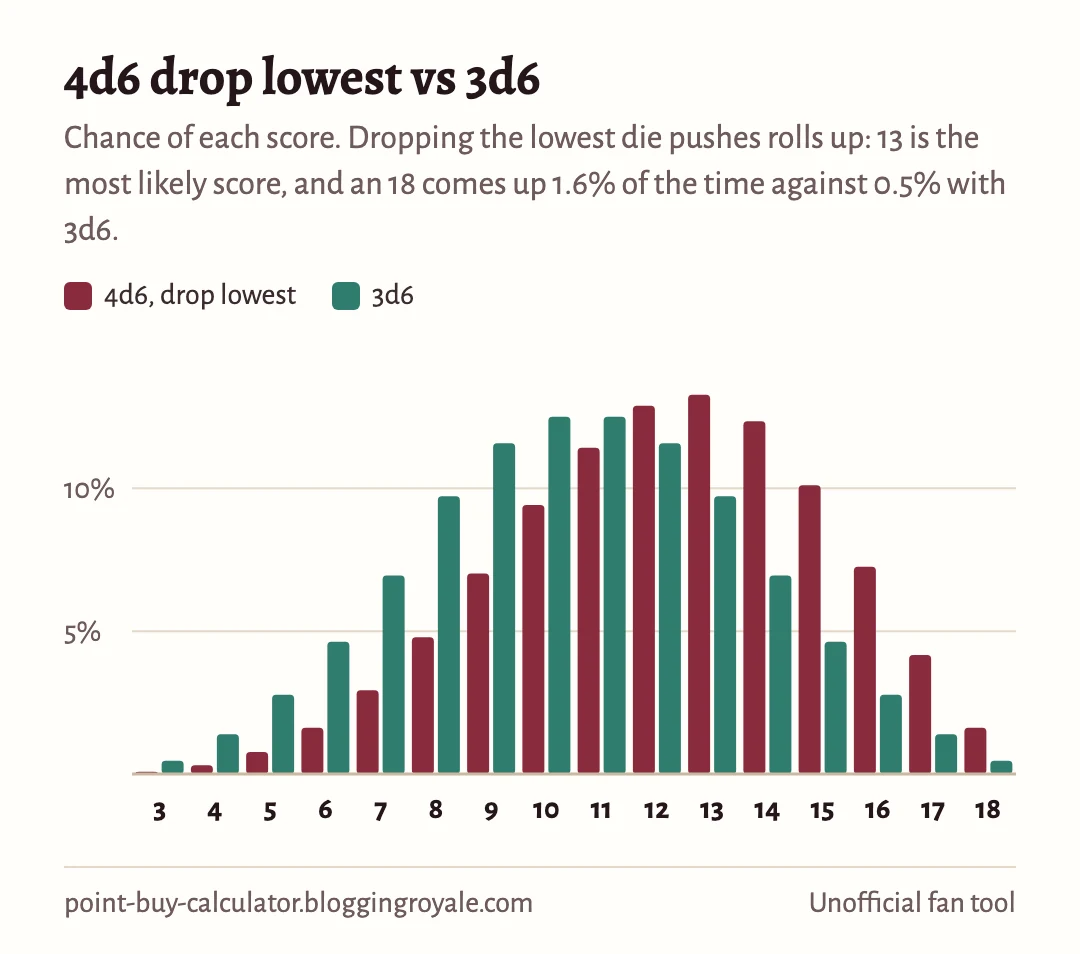
| Score | Modifier | 4d6, drop lowest | This score or higher | 3d6 |
|---|---|---|---|---|
| 3 | −4 | 0.08% | 100.0% | 0.46% |
| 4 | −3 | 0.31% | 99.9% | 1.39% |
| 5 | −3 | 0.77% | 99.6% | 2.78% |
| 6 | −2 | 1.62% | 98.8% | 4.63% |
| 7 | −2 | 2.93% | 97.2% | 6.94% |
| 8 | −1 | 4.78% | 94.3% | 9.72% |
| 9 | −1 | 7.02% | 89.5% | 11.57% |
| 10 | +0 | 9.41% | 82.5% | 12.50% |
| 11 | +0 | 11.42% | 73.1% | 12.50% |
| 12 | +1 | 12.89% | 61.7% | 11.57% |
| 13 | +1 | 13.27% | 48.8% | 9.72% |
| 14 | +2 | 12.35% | 35.5% | 6.94% |
| 15 | +2 | 10.11% | 23.1% | 4.63% |
| 16 | +3 | 7.25% | 13.0% | 2.78% |
| 17 | +3 | 4.17% | 5.8% | 1.39% |
| 18 | +4 | 1.62% | 1.6% | 0.46% |
About 57% of 4d6 sets include at least one 16 or higher. A natural 18 turns up on 1.62% of rolls, so roughly one set in 11 has one.
Rolling methods compared
Only 4d6, drop lowest is in the rules. The others are common table rules. All the numbers below are exact, worked out from every way the dice can land.
| Method | Scores | Average score | Average modifier total | Sets below the standard array | Sets with a score under 8 |
|---|---|---|---|---|---|
| 4d6, drop lowest | 3 to 18 | 12.24 | +5.2 | 41% | 30% |
| 4d6, reroll 1s, drop lowest | 6 to 18 | 13.43 | +8.8 | 8% | 5% |
| 3d6 | 3 to 18 | 10.50 | +0 | 89% | 65% |
| 2d6 + 6 | 8 to 18 | 13.00 | +7.5 | 16% | 0% |
The standard array's modifiers add up to +5. 3d6 averages about +0, so most 3d6 sets come out well below the array. 2d6 + 6 can't roll below 8, and 4d6 with 1s rerolled rarely does.
Worked example: a rolled fighter
Say you roll 16, 14, 13, 11, 10, 7. Choose Start from a class, then Fighter, and the roller puts the 16 on Strength, the 14 on Dexterity, the 13 on Constitution and the 7 on Intelligence. Then pick the Soldier background with +2 Strength and +1 Constitution.
| Ability | Base | Bonus | Final | Modifier |
|---|---|---|---|---|
| Strength | 16 | +2 | 18 | +4 |
| Dexterity | 14 | 0 | 14 | +2 |
| Constitution | 13 | +1 | 14 | +2 |
| Intelligence | 7 | 0 | 7 | −2 |
| Wisdom | 10 | 0 | 10 | +0 |
| Charisma | 11 | 0 | 11 | +0 |
The rolled set's modifiers add up to +4 before the bonus, compared with +5 for the standard array. The bonus lifts Strength to 18 and turns the odd 13 into a 14. The 7 costs a −2 on Intelligence checks, which a fighter can live with.
Rolled scores and the rules
- Range: each score is 3 to 18 before bonuses. Rolling can give you scores that point buy can't, like a 17 or 18, or a 6.
- 2024 rules: your background adds +2 and +1, or +1 to three abilities. No increase can take a score above 20, so a rolled 18 with +2 stops at 20.
- 2014 rules: your race adds its fixed bonuses, as with point buy.
- Fairness: rolling can leave one player far ahead of another. If that matters at your table, use the standard array or the point buy calculator.
The roller also shows what your set would cost in point buy when every score is between 8 and 15. Above 27 means you rolled better than point buy allows.
Related calculators
Frequently asked questions
How do you roll stats in D&D 5e?
Roll four six-sided dice, drop the lowest, and add the other three. Do that six times to get six scores, then put one on each ability. Your background (2024 rules) or race (2014 rules) adds its bonus after that.
What is the average roll for 4d6 drop lowest?
12.24 per score. A full set's modifiers add up to about +5.2 on average, a little more than the standard array's +5.
Is rolling better than point buy?
On average a rolled set is a little stronger than the standard array, but it swings both ways. About 41% of 4d6 sets come out below the array's +5, and about 30% include a score under 8. Point buy gives everyone the same start.
What does 4d6 reroll 1s mean?
A common table rule: any die that shows a 1 is rolled again before you drop the lowest. It raises the average score to 13.43. Pick it under Rolling method if your table uses it.
Can I roll stats in order?
Yes. The roller puts the first roll on Strength, the second on Dexterity and so on, in the order the abilities are listed. Leave them there to play them as they fall, or pick a different number for each ability to move them.
What if I roll really low?
Ask your DM. Many tables let you reroll a set whose modifiers add up to less than a set amount, or swap to the standard array. The D&D 3.5 rules let you reroll if your modifiers added up to 0 or less, or if your highest score was 13 or lower.